Last week, at this very time, I was preparing for Hurricane Irene, which I discussed in this past Saturday's post, and in the conclusion of that entry, I reported that, in regards to Irene, I'd return to blogging with "hopefully little damage to report". Thankfully, that was the case, as I've already indicated earlier this week. I am very grateful to God — though I don't express it nearly as much as I should. In fact, since I sleep on a foam pad — which is directly atop of my floor, I often don't kneel when I say prayers before going to sleep, although I did (as is the standard) kneel at mass yesterday, with thanksgiving that, in terms of Irene, I was unscathed; especially given the damage which Hurricane Irene did cause for many people, including those who live on or near the Jersey Shore, a place, where I took the photograph (posted above) in late July, of a shore town's resident's garden fence with the affirmation, God Answers Knee-Mail. Since the place where I took this photograph is very near the ocean, I hope the folks who own the property as well as their surrounding neighbors did not sustain too much damage, but, whatever the case turned out to be, I am fairly certain they relied on their knee-mail to God to see them through the situation.
And speaking of God; are you, dear reader, familiar with the adage, If you want to make God laugh, tell him your plans" ?
Well, what has happened, dear reader, is that I've recently discovered this very same thing that happens with a muse. If you want to amuse your muse, tell him/her what you intend to write about. For as you may recall, dear reader, last Saturday I confessed that I had planed to write about my "journey towards elegant garden lighting", but my preparation for Irene took precedence. I did promise to return to my garden lighting epiphany today, but I admit that (because I have now been writing this entry in my head for over a week) my insights do not seem as poignant as they did last week, and I am tempted to renege on my promise; not out of an unwillingness to fulfill a task — but out of a bit of pride — that I may not sound as prolific in cyberspace as I do in my head, when it comes to the insights which I thought the new lighting system in my urban garden had taught me.
"Sometimes we regret our failure to write about things that really interest us. The reason we fail is probably because to write about them would prove embarrassing. The things that interested us during the past week, for example, and that we were unable or unwilling to write about (things that stand out clear as pictures in our head) were: the look in the eye of a man whose overcoat, with velvet collar was held together by a bit of string; the appearance of an officer after the building had shut down for the night; the obvious futility of the litter; . . . a man on a bicycle on Fifth Avenue; a short eulogy of John James Audubon, who spent his life loafing around, painting birds; an entry in Art Young's diary about a sick farmer who didn't know what was the matter with himself but thought it was biliousness; and the sudden impulse that we had (and very nearly gratified) to upend a large desk for the satisfaction of seeing everything on it slide off slowly on to the floor," is what E.B. White, (an author I have referenced in previous posts which you may find by clicking here and here as well as here, and here), had to say on the subject of the ideas a writer does not commit to the pencil, pen, typewriter, or keyboard.
However, since I have not upended my desk as of yet, I will return to fulfilling my promise of sharing my journey towards elegant lighting. The lighting in my garden still looks lovely, as evidenced by the "aerial view", of my terrace garden which Juan V photographed (pictured below), this past Thursday, when he came to see how the new "string lighting" and the things which I grow in my garden had fared during Irene; and as you can see, even after all the high winds, and torrents of rain, brought on with her wrath, my urban garden looks serene.

In fact, the lighting looks so elegant that I am bit overwhelmed with joy by the ambiance it adds to my terrace garden. Initially, when I first thought about writing about my journey towards elegant lighting, I had thought that I'd be embarrassed about what the lighting situation within my garden had been during its earliest years; and therefore, the theme of my post regarding it would involve coming to terms with the different person I have been over the years.
Since this approach was my intent, I thought it might be helpful to some of my readers who have had difficulty accepting certain past actions that they have committed; or certain decisions they have made; for I had believed that my studying photographs of my garden's early days would spark the personal and professional inadequacies which I felt during that time (and have struggled to overcome) might be akin to how one reportedly feels when looking at photographs of themselves of bygone days when they were too fat, too thin, had bad hair, were with their ex, and on and on and on; or how they feel when reading journal entries they may have written in bygone years.
"Perhaps it is difficult to see the value in having one's self back in that kind of mood, but I do see it; I think we are well advised to keep on nodding terms with the people we used to be, whether we find them attractive company or not. Otherwise they turn up unannounced and surprise us, come hammering on the mind's door at 4 A.M. of a bad night and demand to know who deserted them, who betrayed them, who is going to make amends. We forget all too soon the things we thought we could never forget. We forget the loves and the betrayals alike, forget what we whispered and what we screamed, forget who we were. I have already lost touch with a couple of people I used to be; one of them a seventeen year-old, presents little threat . . . the other one, a twenty-three year old, bothers me more. She was always a good deal of trouble, and I suspect she will reappear when I least want to see her, skirts too long, shy to the point of aggravation, always the injured party, full of recriminations and little hurts and stories I do not want to hear again, at once saddening me and angering me with her vulnerability and ignorance, an apparition all the more insistent for being so long banished.
"It is a good idea, then, to keep in touch and I suppose that keeping in touch is what notebooks are all about," Joan Didion writes in her essay, On Keeping a Notebook, and, although I do not keep a notebook, diary, or journal, I do agree with Ms. Didion (a writer I've cited in several posts which you may access by going to the labels menu on my blog, located to the left of all blog entries and selecting Joan Didion), and, in fact, I think that snapshots also have the power to drive one back on to oneself — at least they do for me; which is why I thought that my reviewing them would bring on emotions that have been pushed aside, and allow me to share my journey of lighting within myself as it paralleled the various ways I have lit my garden over the years.
But, once again, as it did last week, the aforementioned muse laughed when I told it my plans regarding the content of today's blog post; and, as it turns out, it is more of a chronicle of my various urban garden lighting methods without the underlying meanings that may or may not have accompanied them, which I hope that those who appreciate gardens and gardening will enjoy; as for my intended thought to philosophize about the deeper meaning involved, I am resigned to believing that, in this instance, it could very well be that "a spade is just a spade" .
However, I am sure you will agree that September does bring out the philosopher in folks; the type of philosopher which the American poet Emily Dickinson describes in her poem, September's Baccalaureate which is posted below:
September's Baccalaureate
A combination Of Crickets — Crows — and Retrospects
And a dissembling Breeze
That hints without assuming —
An Innuendo sear
That makes the Heart put up its Fun
And turn Philosopher.
Upon recalling Dickinson's poem, in an effort (Or is it a justification?) to document my outdoor lighting journey, I did go through the photographs that I have of my urban garden. One of the earliest photographs I can find of my garden is from 2002 (seen below) when I'd already been living in my studio apartment with its "attached" outdoor space for nearly nine years, and, when I look at this photograph now, I think my garden looked timid, but then maybe I am projecting how I felt about myself and gardening during those early green thumb years.

Perhaps you recognize the image posted above, dear reader, because I included it in a blog entry titled, I Have NEVER Seen A Billboard Lovely As A Tree, that I posted this past May, when I had taken down the SODAS sign, which had maintained quite a presence in my garden for a number of years, and, in fact, it often "dictated" where my herbs, vines, plants, flowers, shrubs and trees were ultimately placed during its "reign".
In the aforementioned month of May blog entry, I pointed out that looking through past photographs of my urban garden — particularly in its earliest years — often causes me to "feel vulnerable, because they reveal my then lack of talents as a gardener (which have taken a while to develop)", but, because that blog entry, as well as this one, are about the removal of a longstanding object, "and not my own stages as a gardener", I will once again — as I did with the evolution of my SODAS sign — share photographs with you about the evolution of another object that has been in my terrace garden, and that is my outdoor lights. I'll start with the first image that I used when recounting my SODAS sign journey (which is the image above). However, this image is slightly different, in comparison to the image I used this past May, because I have added three arrows to it; in an attempt to illustrate part of what I am discussing today.
To provide you with a little orientation: My terrace garden is actually a roof extension and it is "enclosed" by a low railing that goes around it. This railing is made up of three metal "tiers", and when I first moved into my apartment (which I did during the night-time hours) I discovered the former tenant had left a small strand of white "Christmas" lights dangling over one of the "tiers". This turned out to be quite a blessing because, as it happens, there was not one light bulb in the fixtures within the apartment, so I brought the small strand inside and used it for "regular" light, until I could get to the store to buy bulbs for my fixtures.
Soon after I settled into my new home, upon being inspired by seeing how the former tenant's lights looked outside, I subsequently strung many strands of lights outside — not just a small strand — I put lights around each of the three "tiers" as I wanted to have a look of ivy, and it seems strange now that, at that time, I never thought about having real ivy. My "tiers" of lighting can be seen by looking at the arrows seen in the image above. The purple arrow is pointing towards strands of lights that made their way around the entire first "tier" of my terrace; and the gold arrow is pointing towards lights which made their way around the entire second "tier"; the third "tier" is obscured in this photograph, hence there is no arrow pointing towards it, but their is a third arrow, which is chartreuse-colored, and it is also pointing towards lights that I put in my terrace garden the same day I put lights on all three "tiers" of railing.
Here's a mini-back-story as to what these "other" lights are about: As it happens, another "feature" which came with my terrace is a tall "pole/pipe" situated in the northwest corner of my terrace, and I strung lights up and down that "pole/pipe", which is where the chartreuse-colored arrow is pointing. These particular lights were the kind which can be wrapped around a tree trunk — as I wanted the illusion of having a tree in my "yard", never thinking, never dreaming even, that one day I'd have seven trees growing in containers; including two larches (a small Japanese Larch AKA Larix Kaempferi and a tall one), 'Tamukeyama' AKA Japanese Red Maple, an Acer palmatum AKA 'Shisitatsu' Sawa, an Acer shirasawanum AKA Autumn Moon, a Fagus sylvatica AKA Beech Tree, and a Physocarpus opulifolius AKA Coppertina; which are all thriving.
Losing the Spruce was traumatic, because, at the time, it was the only tree which I had in my garden as seen in the photograph below:

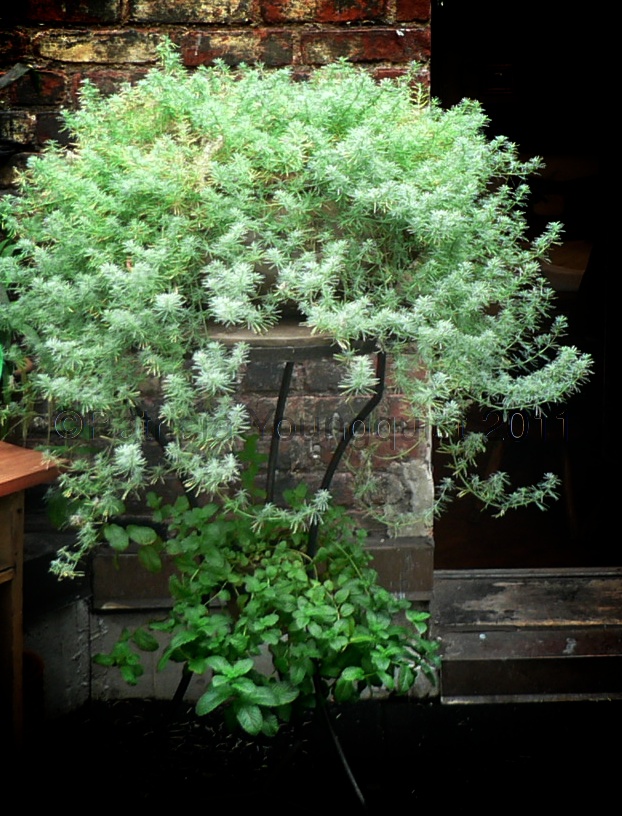
This image is drastically different from my garden today, but it is part of my growth as a gardener. The orange arrow is pointing to the Spruce; my only tree at the time; the leaves from a tree that you can see in the upper right hand corner are from the pesky Ailanthus Trees, which many folks on my block (and all over New York City) have in their yards. The black arrow is pointing at a Silver Mound plant, an annual I had in my terrace garden for a number of years, mostly because of its tactile feature (very soft and fuzzy to the touch) and, while it was interesting to have, it tended to get leggy and take over my garden space, so for the past six years I have not included it in the landscape of my garden.
The purple arrow with tips on either side of it is pointing to the lights that were on the three "tiers" surrounding my terrace. Lastly, the red arrows are pointing to my "pole/pipe" with the lights strewn around it. The "pole/pipe" became my quasi-tree in my early garden years, and various vines, which were planted in containers at the "pole/pipe's" base, enjoyed hopping on it, and they ultimately trailed up it, as seen in one of my early endeavors as a gardener in the images posted below. (These images were taken by Patricia Rosa who I have referred to in prior blog entries which can be accessed by clicking here and here as well as here.)


The little white flowers, that can be seen in the containers at the base of this flourishing Morning Glory Vine; are Asylum flowers, which were a delight to me in my early years; but now that I have very few annuals in my garden, I no longer include them in my "landscape". In any event, Patricia Rosa's photographs depict a very different garden than the one I have today, and BTW, if you look at the three white "tiers" of my railing in her photographs, you will see that they all have strands and strands of lights.
As for the vine that took over the "pole/pipe" in Ms. Rosa's images; it is a Morning Glory, a vine, which I have not had for many years since I made the switch to perennial Clematis Vines which can be seen in various stages of growth where the orange arrows are pointing in the image below. The black arrow is pointing to my beloved Karamatsu, the tree that I just mentioned, who lost its life to grubs last September.

I have referred to my replacing Morning Glory Vines with Clematis in a previous post which you may refer to by clicking here. My first Clematis and the "pole/pipe" lighting can also be seen in the following image with the short-lived Spruce in the back to the left.

This particular Clematis, has been featured in my line of invitations that preserve a moment in time, my event program covers which enhance any occasion, and my greeting cards that are about more than communication. All of these are available in the store-front pages of my web-site, Patricia Youngquist Photo Art, as well as in a downloadable brochure which you may access by clicking here.
However, the following season I had to replace my white Clematis with H.F. Young Clematis, a vine, which has flourished every year; as evidenced by the photograph below (a variation of this image was included with an informative narrative in a previous blog entry that you may access by clicking here).

I confess it was this H.F. Young's month of May birthing of dozens and dozens of the H.F. Young Flowers that prompted me to begin to regret having lights around my "pole/pipe" — for I felt the cords and the plugs were interfering with the esthetics of my H.F. Clematis Vine, (even though you can barely see them here) especially since I like to photograph this vine long after the flower's gone as evidenced by the image below.

The ability to get a nice image of what grows up my "pole/pipe" without a light bulb, cord or plug "mugging" the shot has not been easy, and this factored into my decision to remove the lights from the "pole/pipe".
The railing lights had been the first group of lights that I took down, an endeavor you my recall from this past December, when I blogged about my taking down lights at a time when people were putting them up for the holiday season. You may remember, dear reader, that I stated that I had decided to do this because I felt the wires and cords of the lights were interfering with the branches of my lovely Actinida kolomikta and Actimida (Kiwi Vines) which you might surmise from the photographs below that you may remember from having seen them in a November 2010 blog entry.


I know that my Actinida kolomikta and Actimida (Kiwi Vines) appreciated the "breathing room" allotted to them (once I took down the railing lights in December of 2010) because one of the Kiwi Vines, the Actinida kolomikta, made reference to it when he was featured as the narrator in my first garden-themed movie, The Kiwi Speaks! Fifteen Minutes of Fame . . . almost, which is now on Vimeo and you may refer to this link for details.
However, even though I removed the railing lights last December, it has taken me until last week to remove the ones from my "pole/pipe", and those lights, like the SODAS signs were once a key player within the objects I have in my terrace garden; as evidenced by a photograph that Donna De Solis took this past December, a few days after I had wrapped all my herbs, vines, plants, flowers, trees and shrubs for the winter. This photograph was featured in a blog entry at that time, but since I am referring to the "pole/pipe" in this instance, I thought it appropriate to include this photograph even though it's been seen by many of you.

In the case of De Solis's image, the "pole/pipe" lights are not interfering with any flowers from any vines, because it was December, and things had gone to sleep until spring; but while it may look festive at night, during the day, cords wrapped around the pole with un-lit bulbs were far from festive and, in fact, they often drew attention to the temporarily dried up vines.
Another item featured in De Solis's image depicts how I used lighting for specific Christmas decor. In the top right hand corner of her photograph there is a star which, in the image, may appear as if it is at the top of my Larch Tree, but in fact these lights are wrapped around a bamboo pole which, during winter-time, I use to give my Larch support against winter elements. The star is attached to the top of the pole, providing an illusion that it is affixed to my Larch, which is actually too tender to take the weight of this type of decoration.
As for the lights seen in front of the "pole/pipe" on the left hand side of this image, they are actually mixed within a wreath that is sitting on a table-top turned plant stand, which had been used to "house" the container for my Fagus sylvatica (Beech Tree), and when it was performing this function t looked like this (see photo-collage posted below):

It was (and still is) a great use of the table-top, but when I winterized my herbs, vines, flowers, plants, shrubs, and trees last December, they were all moved to the southern portion of my terrace, which in the case of my Fagus sylvatica (Beech Tree), meant that I had an empty stand.
The empty stand looked all right, but in an attempt to give my H.F. Clematis "company" (since the stand is so close to the poles where the H.f. Young Clematis attached itself) during winter-time since it was one of three things which could not be moved, I placed a Christmas wreath with lights atop of the stand. These are the lights I referred to in the previous paragraph. The following image of the wreath used in this manner was also featured within in a blog post on December the 15th 2010.

Once the 2010 winter had finally passed, and my wreath was discarded so that my Fagus sylvatica could move back into his digs, the wreath's lights were kept, and put on the rim of my Fagus sylvatica's stand (as evidenced in the photographs which were taken during different seasons in 2010 and are posted below).


The lights around the rim of the table-top-turned-tree-stand are the only lights still remaining in my garden from previous lighting endeavors, and I have yet to make my "executive decision": if these lights will remain there now that I have the string lights hanging above my garden. Juan V thinks they looked nice when my Christmas wreath was there, and I do admit, having special lights in my garden for the holidays creates a festive mood, as seen in the five photographs below, depicting my prior use of Halloween lighting in my garden.


Because holiday lights are so festive, "the jury" (the things I grow in my terrace garden) is still out on whether or not I will incorporate them this year.
One of my perennial vines, the Autumn Clematis AKA Donna the Grower's Legacy , can be seen in the fourth picture of these five photographs (taken in October of 2010) climbing on a wooden lattice before heading up to the trivets which Juan V placed on the wall in May of 2010. It is hard to see it (the Autumn Clematis) in the fifth photograph; in this instance, it's the lighting that I wanted you to see.
The Autumn Clematis blooms in the autumn, hence its name, Autumn Clematis. Since the Autumn Clematis is the one who lives 24/7 with any lighting system which I install (especially because, for the most part, it faces my "pole/pipe"), it will be one of the key players in weighing in on any future decisions regarding my terrace garden's lighting; and, dear reader, you are welcome to weigh in as well by posting a comment.
Meanwhile, my Autumn Clematis is ready to burst with its white flowers (as evidenced in the photographs of it posted below, including one with a rose to give you a sense of the size of the bulbs in the string lighting) as it anticipates the view it will have within the string lighting of my garden.