Showing posts with label Thymus (Thyme). Show all posts

Wednesday, December 29, 2010

Rosmarinus officinalis (Rosemary) "Rosemary is for rememberance"


This is the 363rd day of 2010, and there are only two more days of this decade (in the Gregorian calender) after today passes. The promise of the onset of a new year is an occasion for me to send a card to people who bring meaning to my life. While you may not have time to go on my on-line viewing sources to choose a card for you to do the same, I do have a beautiful selection of cards in the store-front pages of my web-site, and I hope you will make it a New Year's resolution to reach out to your colleagues, friends and family from time to time by sending them a card for the array of events that  are bound to occur during the course of  the new year for all persons.

As an urban gardener, I often include herbs with my correspondence, particularly  at the onset of a new year, when I like to accompany my greeting with rosemary an herb I grow in my roof-extension garden. This herb is also a 'subject' of one of my petite wrap-around cards as seen below).


During warmer months, I include a sprig of fresh rosemary as it is a symbol of friendship. However, since I am unable to include a fresh sprig during winter months, I harvest and dry my rosemary: rosemary that I grow in a variety of containers on my roof-top extension garden, as seen in the "window" box propped on an old piano bench in this "card" image, and also seen with its Simon and Garfunkel comrades "parsley, sage and thyme", huddled together in an old-fashioned metal milk-bottle holder, and captured in a photo at the top of this post (where they are posing below my Rosemary triplets that are shaped into a lovely topiary). Since I cannot send a fresh sprig of rosemary during winter months, I prepare it in another way. When I do my garden winterizing (various winterizing methods have been discussed in a previous post which you can view here), I cut back my rosemary, dry it, then I grind it and put it into small jars (as shown below):


to give as New Year's gifts. Rosemary is an herb that is wonderful to use for culinary purposes if you are so inclined, but it is also an herb that is a symbol of friendship, so it is great to include in a correspondence when expressing appreciation to someone in your life.


I am prompted to include rosemary with New Year's wishes by Ophelia, who in Hamlet, reminds us that "Rosemary means remembrance," and this is not the first quote of Ophelia's that inspires my card sending, as you may recall from a previous post entered on this past Valentine's day which you may refer to by clicking here. BTW, sending rosemary at the start of a new year, because of its association with remembrance, also addresses the rhetorical question asked in the traditional new year' s song, Old Lang Syne, as to whether it is right that old times be forgotten. This song is generally interpreted as an invitation to remember those near and dear to our heart and evidenced by sending a card.



Tuesday, November 16, 2010

Turning the Tables in Garden Decor


The ability to define my goals in salient points does not come easily to me. It never has. I tend to view most matters in layers and get caught up in possibilities. As a young junior high-school student, I agonized over the standardized PSAT when it came to multiple choice questions. The traditional choices for those test questions was usually something like this: Sometimes option "a" but never option "b" when "e" and "f" are present. On one occasion, when I questioned the teacher about various scenarios (which were delaying me from being able to go on to the next page), I was put out in the hallway, with masking tape bound over my mouth, and told "when you are ready to stop asking questions and make a quick choice you, can come back to the classroom."


This problem of taking too much time to weigh the answers in multiple-choice test questions occurred in test-taking again, when I was in high-school and took the SAT. There was a test question about how many clothes-pins it would take to hang laundry on a clothes-line. I found myself thinking, 'hmmmm, that depends . . . is the clothing heavy jeans and towels, or is it something light such as under garments?' I lost all my test taking time on those types of test questions, and since SAT scores are based on time as well as knowledge.


Fortunately, I passed the SATs with a score high enough to get into college, and I used my layered thinking to my advantage, graduating from the university with honors. My graduating from college, and my deliberating over option A and option B in relation to test questions, was a number of years ago, but the inclination to consider various scenarios of a given issue still prevails. 

For example, nearly ten years ago I found a wooden table (an image of it can be seen in the image at the top of this posting) at a local Flea Market. It seemed like quite a find at the time because it "matched" two chairs that I already owned. The table turned out to be a bit too high for the enjoyment of herb infused cocktails when sitting in those chairs, so I had to replace it which I did with a find from a used furniture shop, and it has been a mainstay in my urban garden for years to come which can be seen in photos that include the table in a previous post.


As for the fate of the wooden table, being a layered thinker, I turned it into a stand, specifically a "salad bar" where I attempted to grow salad greens such as tatsoi, dandelion, red lettuce, green lettuce, and green mustard (as seen below).


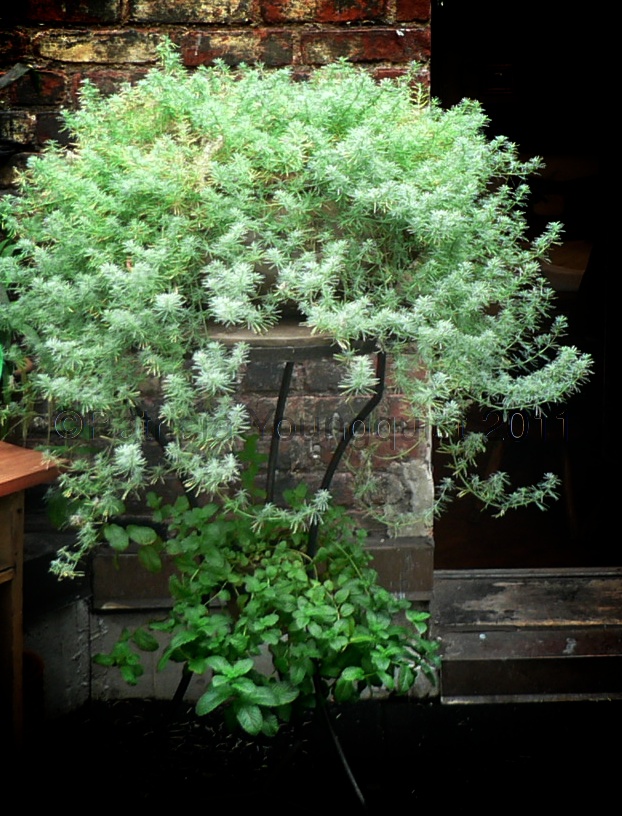
It had been my hope that my dinner guests could pick their own salad. I quickly learned that no mater how much loving care I gave my salad greens (and reds), they did not grow very well in terra-cotta containers. Therefore, over the following years the table supported a terra-cotta bowl filled with either Dragon's Blood Red Sedum plants, Amazon Sunset plants, Ajuga plants, and even Thymus Argenetus (Silver Thyme) plants. This can be seen in the corresponding photographs posted below.


Of course, this answer for the use of my table proved to be far from infinite. The table-top's wood became increasingly stressed by my watering the various plants, and by the table-top being subject to outdoor conditions of rain, hail, sleet and snow. The table-top's wood eventually warped, but I had every intention of replacing it — with lumber that I could order cut to size — so I could continue using the table as a plant stand.


Doing this became unnecessary when another layered thinker, Juan (who did the trivet installation for my Cheerful Cherry Farm Autumn Clematis to climb upon, which  I wrote about in a previous post), removed the wood, and placed my potted Fagus sylvaitca (Beech Tree) into the table's remaining rim. The result was extraordinary as seen in the images below.


Not only does my Beech Tree appear to love its new "home;" the passion vine, trailing on the rail behind it, is flourishing too. Moreover my 'Shigitatsu Sawa'- seen here with its golden-rose autumn leaves — enjoys (evidenced by its thriving) being alongside it. (An image of the 'Shigitatsu Sawas' leaves in front of the rim of the Beech Tree's pot was seen in a previous post.) BTW, Juan used the old wood from the table as a "footer" to balance one of  my heavy pots containing a shrub - truly turning the table's use in my garden.

Saturday, June 19, 2010

parsley, sage, rosemary and THYME


The scents from my herbs remind me that I have much more in my urban garden than my Paeonia suffruitticosa, Clematis lanuginosa, and H.F. Young Clemantis. In fact, the number of my trees, shrubs, flowering plants and herbs totals a little over fifty. My variety of herbs grow with a sense of purpose, providing heavy aromas which often attract honey bees - especially the lavender and thyme. Thymus, the last of the "Simon and Garfunkel herbs" (Parsley, Sage, Rosemary and Thyme) is certainly not last with me. I have three types of thyme in my garden. My Thymus vulgaris (English thyme) has small with gray green leaves. It is excellent in a liqueur.

It enhances  a variety of foods, including soups, sauces, herb butters and vinegars. It is an essential component in in the blend of herbs known as bouquet garni. I grow it in a terra-cotta clay-bowl, and like to watch its fabulous foliage trail over the top of the container. My Thymus citriodorus ('Aureus' or variegated lemon thyme), like its sister, is grown in a lovely, low, terra-cotta clay-bowl. This variety has gold-splashed leaves and their lemon scent makes them a culinary delight. The honey-bees love this plant, and I love the lemon-thyme honey that results from their endeavors. My Thymus citrioorus ('Argenteus' or silver-edged thyme) is also a culinary delight and a bouquet garni essential. This type of thyme is a bushy, rounded shrub with white edged leaves. Like the others, Thymus vulgaris and Thymus citriodous ', I grow it in a low terra-cotta clay-bowl and watch it spill over the bowl. I have rendered an image of this into an invitation which can be seen at the top of this post. It is available for purchase on my web-site.


Related Posts Plugin for WordPress, Blogger...