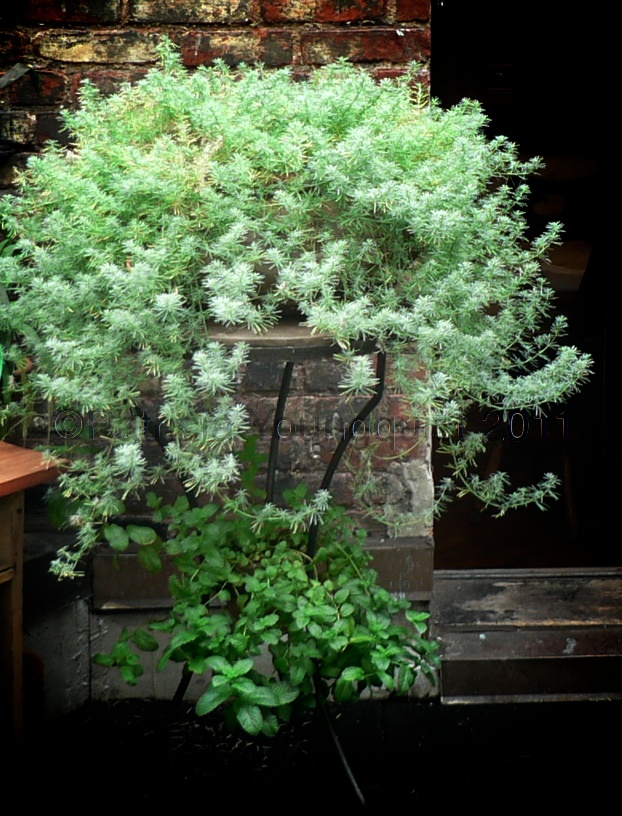
If you have been following my blog for a while, or even if you just started reading it yesterday, you may realize that something is missing in the photograph posted above of my urban terrace garden, and I’ll give you a clue. It is an object that is bigger than a bread box, and has always been located at the northern end since I began my garden, which is the vantage point of many photographs which have appeared in many of my blog entries. (The object is also a focal point in some of the aforementioned creations, including those titled Serene and Before Brunch in the Terrace Garden, which can be found in the store–front pages of my website).
Big clue: this object is known by two words, the first word begins with an “S” and ends with an “S” and the second word has four letters. (I’ve included a little “thinking music” by way of the You Tube audio posted directly below, for you to play, dear reader, whilst you ponder this change in my terrace garden arrangement might be.)
If you suspected that the answer to what’s missing is a “SODAS” sign, you are correct, but unfortunately at the moment, I have no prize to offer you for a correct answer, other than hoping you feel some satisfaction in your powers of observation. The decision to remove the “SODAS” sign has been germinating for quite some time now, but actually taking it down was a big moment for me — and perhaps, dear reader, as you read today’s blog entry, you will recall a time when you have done something similar in your own life, whether its rearranging a physical space by putting something up as well as taking something down, or rethinking approaches to how you look at things.
My “SODAS” sign seen in the photograph below,

where it has been propped against the door that leads to and from my terrace garden to my apartment, is something I purchased in the late 1970’s, when I was in college and attending Illinois State University (I.S.U.), and it is perhaps one of my only good memories of the time I spent in the Bloomington/Normal area where I.S.U. is located. I ultimately left the university without procuring a degree from there.
However, I did accumulate a hefty college loan, as well as receiving a transcript with 176 credits, which were a result of having changed my major every other semester; an action taken by me in the hopes that a changed major would somehow obliterate my having Neurofibromatosis (N.F.) — a medical condition that I was born with (discussed in two previous blog entries which can be read by clicking here as well as here). The symptoms of my condition were becoming much more pronounced during those years, forcing me to leave the university to seek medical treatment in California, to hopefully rule out, or to treat (with brain surgery or undergo a treatment through my ear, if need be), an acoustic neuroma, a symptom of N.F. It was a frightening time for me, because, during those years, very little was known about N.F., and I was on–my–own going around the country to seek treatment and to undergo painful tests. Additionally, during those years, N.F. was known to be only brought on by heredity, and since nobody on either side of my family has this neurological condition, the arguments within my family’s unit that were raised as a result of this medical “fact” added to my misery.
The medical community now knows that N.F. can be a result of having a mutated chromosome, identified as Chromosome #17. This is a fact that was brought to my attention in a chance meeting with a woman on Columbus Avenue, in the late nineties, around the time I attached my “SODAS” sign to the rail of my terrace garden after having it hanging in the kitchenette of my studio apartment.
Fortunately, whenever I've seen this sign in my garden, I do not think of I.S.U., and I say this to you, dear reader, because I find that often when I look at a material possession, it has the power to remind. Therefore, it is surprising to me that when I’ve looked at this sign, I have not seen the mistakes I made while at I.S.U. Nor have I indulged (as Joan Didion so nicely puts it in her essay called On Self–Respect), in “counting up [my] sins of commission and omission, the trusts betrayed (towards me and trusts I’ve betrayed), the promises subtly broken (those made to me, those I’ve made to others), the gifts irrevocably wasted through sloth or cowardice or carelessness.”
However, my looking at past photographs of the “SODAS” sign in my terrace garden does have the power to remind me of my previous years in gardening, and sharing some of these images with you, dear reader, makes me feel vulnerable, because they reveal my then lack of talents as a gardener (which have taken a while to develop), but because this post is about the removal of long–standing object, and not about my own stages as a gardener, I will share some pictures of the “SODAS” sign’s years in the garden. (Please look below.)

PHOTO–A
The photograph posted above (which I will call Photo A for purposes of this blog narrative) is a picture taken during one of my first years of gardening, and when I look at it, I do not focus on the “SODAS” sign per se; rather I cringe with embarrassment at some of the choices I made in terms of the vines, plants, shrubs and flowers which I had in my garden at that time. This brings me back to a vulnerability I had during those days, knowing that my garden screamed “novice” with a taste for airport art. I confess that I did not know much about gardening then, but fortunately, in New York City, there are many Greenmarkets chocked full of choices of what one can plant. However, during my early garden years, it seemed to me that, for the most part, the growers who sold what they grew on their farms and in their greenhouses had little time or concern for novice gardeners. There is an element of haughtiness in New York City (and perhaps elsewhere too), when it comes to sellers imparting information to buyers particularly in certain bicycle shops, camera shops, and most definitely at some flower shops; as well as greenmarkets. This not only a haughtiness, but it is also an air of snobbery designed (perhaps unwittingly), to separate the cool-in-the-knows from the just-learning.
But, as I write this post today, I admit that in the past few years, unlike my early garden years, I have had terrific and inspirational encounters with many Greenmarket growers, and there seems to have been a shift in attitude of sellers, which is perhaps caused by a poor economy forcing sellers to “make nice” towards potential buyers, or maybe the kinder–information–sharing attitudes from growers that I am experiencing now, is because I know so much more now about gardening, and, therefore, I may have gained some respect. That is to say, my knowing the names of herbs, plants, trees, and shrubs, and the conditions which they need to thrive in a garden, seems to have won me a certain rite of passage. At least I feel more comfortable knowing the names of various herbs, plants, vines, shrubs, and trees, like the feeling one might have when traveling to another country and speaking (even if it is just a little) of the language. In fact, it has been my observation that when one travels to another country, if they try and speak the language — even if it is only a little bit of that language — they are more likely to receive the information that they need (and may not even get if they knew nothing or too little about the language).
This is both understandable and sad. Understandable, because if one needs information, then they should probably have some clues about what they want to know (be it the directions to a place in a land where they don’t speak the native language fluently, or if they are new to cycling and need to procure the proper apparel, or if they are wondering about an ingredient in cooking when they are new to cuisine based endeavors, or whatever task one is undertaking for which they need information — including what might thrive in their garden if they are just beginning to exercise their green thumb.
However, the lack of willingness to impart information is mostly sad. Sad, because when folks do not want to share what they know for whatever reason, or to take the time to give information to new–bes, that is selfish and somewhat mean-spirited: revealing an impatience that seems to be permeating our culture today — a culture so desperately in need of of folks reaching out to each other, even if it is just to ask if something will or will not thrive in direct sun light or a northern exposure. For, if we all are “on–our–own” when it comes to giving and receiving information, it is a sad commentary indeed. Nonetheless, in my early days of gardening, it was very hard to get answers to questions, and while I would not say I that I learned the hard way (for in gardening there is no hard way), I would say this is a case where I wish I knew then what I know now.
This is not always true for me, I have leaned more towards the somehow being better off when I didn’t know mode. The type of mode Joan Didion describes (in her essay, Goodbye to All That) when giving an account of the first years she lived in New York City: ‥ . . . I would stay just six months and could see the Brooklyn Bridge from my window. As it turned out it was the Triborough, and I stayed eight years. . . . In retrospect it seems that those days before I knew the names of all the bridges were happier . . . .” Like Didion, the pain I have experienced from knowing the true picture has made the fantasy wide–eyed moments much more appealing — however not when it comes to gardening. I like knowing all the names (both Latin and “Common”). I like knowing their growing conditions and having a basic sense of how they will “perform” in my garden, because no matter what, they never fail to surprise me, and my having a basic understanding of my herbs, plants, vines, shrubs and trees allows me to appreciate their nuances even more.
Still, in addition to the self-concious and awkwardly placed plant choices seen in the photograph — the third photograph from the top of this post — which I have labeled PHOTO–A, my “SODAS” sign is present. The sign was initially attached to the railing that surrounds my terrace garden by Gerson, a young man from Brazil (and used to enjoying being outside), who was making repairs to my studio apartment after the ceiling had collapsed inside of it (an incident I discussed in a previous post, which was one of my very first blog entries, titled America’s Answer to Guy de Maupassant: The Inspiration Behind the Title to my Blog, The Last Leaf Gardener).
The “SODAS” sign has been in my terrace garden almost twelve years, and, during that time, my garden has changed dramatically over the years, with the inclusion and elimination of various herbs, plants, vines, shrubs, and trees, as seen in the following pictures of my garden’s evolution (over the years 2006–2009, with the SODA sign remaining amidst the changes.

PHOTO–B
PHOTO–B, known as Summer Afternoon in the Terrace Garden (AKA Urban Rooftop Garden: Mid-Summer Afternoon) and was one of my limited edition greeting cards.However, even though the “SODAS” sign and the marble topped table have remained in my terrace garden, the herbs, vines, plants, shrubs, and trees that I grow have changed dramatically.
The same holds true for PHOTO–C (Before Lunch in the Terrace Garden) and PHOTO–D (Serene) posted below, except these latter two can be viewed both in my on–line brochure as well as in the store–front pages of my web–site, where purchase information is available.

PHOTO–C (Above)

PHOTO–D (Above)
The photographs below were also taken during early garden endeavors, but they have not been rendered into cards at this time, however, they have been included for purposes of this blog post, to document the stagnancy or consistency of the “SODAS” sign amidst the ever changing terrace garden.

PHOTO–E (Above)

PHOTO–F(Above)
The “SODAS” sign always proved to be a topic of conversation when entertaining guests in my terrace garden soirées, particularly whilst sipping glasses of chilled Vin de Pays de l’Hérault or Bourgogne Aligoté, during the “merry, merry month of May” or drinking from steaming mugs of Knob–Hill Chuao Hot Chocolate on a Halloween night
Additionally, the “SODAS” sign proved to be a bench marker of the amount of snowfall as seen in the photographs below taken during various years of my terrace garden winterizing.

PHOTO–G (Above: Winterizing 07-08)

PHOTO–H (Above: Winterizing 07-08)

PHOTO–I (Above: Winterizing 08-09)

PHOTO–J (Above: Winterizing 08-09)

PHOTO–K (Above: Winterizing 08-09)

PHOTO–L (Above: Winterizing 08-09)

PHOTO–M (Above: Winterizing 09-010)
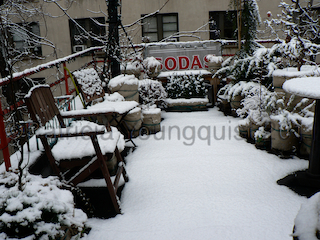
PHOTO–N (Above: Winterizing 09-010)

PHOTO–O (Above: Winterizing 09-010)

PHOTO–P (Above: Winterizing 010-011)

PHOTO–Q (Above: Winterizing 010-011)

PHOTO–R (Above: Winterizing 010-011)

PHOTO–S (Above: Winterizing 010-011)

PHOTO–T (Above: Winterizing 010-011)
And, with PHOTO–T, this brings me to the first few months of this season’s garden on my terrace, and the last few shots of terrace garden with the “SODAS” sign,

PHOTO–U (Above)

PHOTO–V (Above)
before I took it down the other day, and if you have made it this far looking at the variety of photographs in this blog post, dear reader, you have a right to question, why take the “SODAS” sign down after all these years of having it make such a presence in my terrace garden?
The answer to that (and in determining this answer, if you’d like, you can scroll up and replay the “think music” from You Tube, which is near the beginning of this blog entry), is the arrival of a Larix leptolepsis, a tree that Juan V was able to get for me after knowing that a little Larix leptolepsis which I loved had been attacked by beetles and died, an occurrence that I wrote about in a previous post.
This sweet little tree can be seen in the right hand corner of the photograph, just in front of the final “S” in the word, SODAS. Unfortunately, the final “S” in SODAS is distracting from the ability to see the outline of the Larix’s branches and beautiful needles and the first “S” of SODAS to the left in this photograph is distracting from the branches of my Acer palmatum (“Shisitatsu” Sawa), a tree that you may recall reading about in previous posts including the one here.
Therefore, when the “SODAS” sign started to “compete” with the ability to see the outline of the branches of my trees, I felt it was time to take it down from its location in the garden, and at this time there is no other place in the garden that it can go. How do I feel about removing such a longstanding “fixture” in my garden? The answer is in the title of this blog post (and Joyce Kilmer and Odgen Nash have the answers).
Here is Joyce Kilmer’s answer (whose poem I have included in two previous posts which you will find here and here):
I think that I shall never see,
A poem lovely as a tree.
A tree whose hungry mouth is prest,
Against the earth’s sweet flowing breast;
A tree that looks at God all day,
And lifts her leafy arms to pray:
A tree that may in summer wear
A nest of robins in her hair:
Upon whose bosom snow has lain:
Who intimately lives with rain.
Poems were made by fools like me,
But only God can make a tree.
And here is Odgen Nash’s answer (the poet referenced in today’s blog title):
I think that I shall never see
A billboard lovely as a tree.
Indeed unless the billboards fall,
I'll never see a tree at all.
A billboard lovely as a tree.
Indeed unless the billboards fall,
I'll never see a tree at all.

My Acer palmatum (“Shisitasu” Sawa) has been moved to another part of the terrace since the “SODAS” sign was removed, but, my Acer shirasa wanum (Autumn Moon) and my Larix leptolepsis (pictured above) seem to enjoy the “renovated” environment, sans the “SODAS” sign.